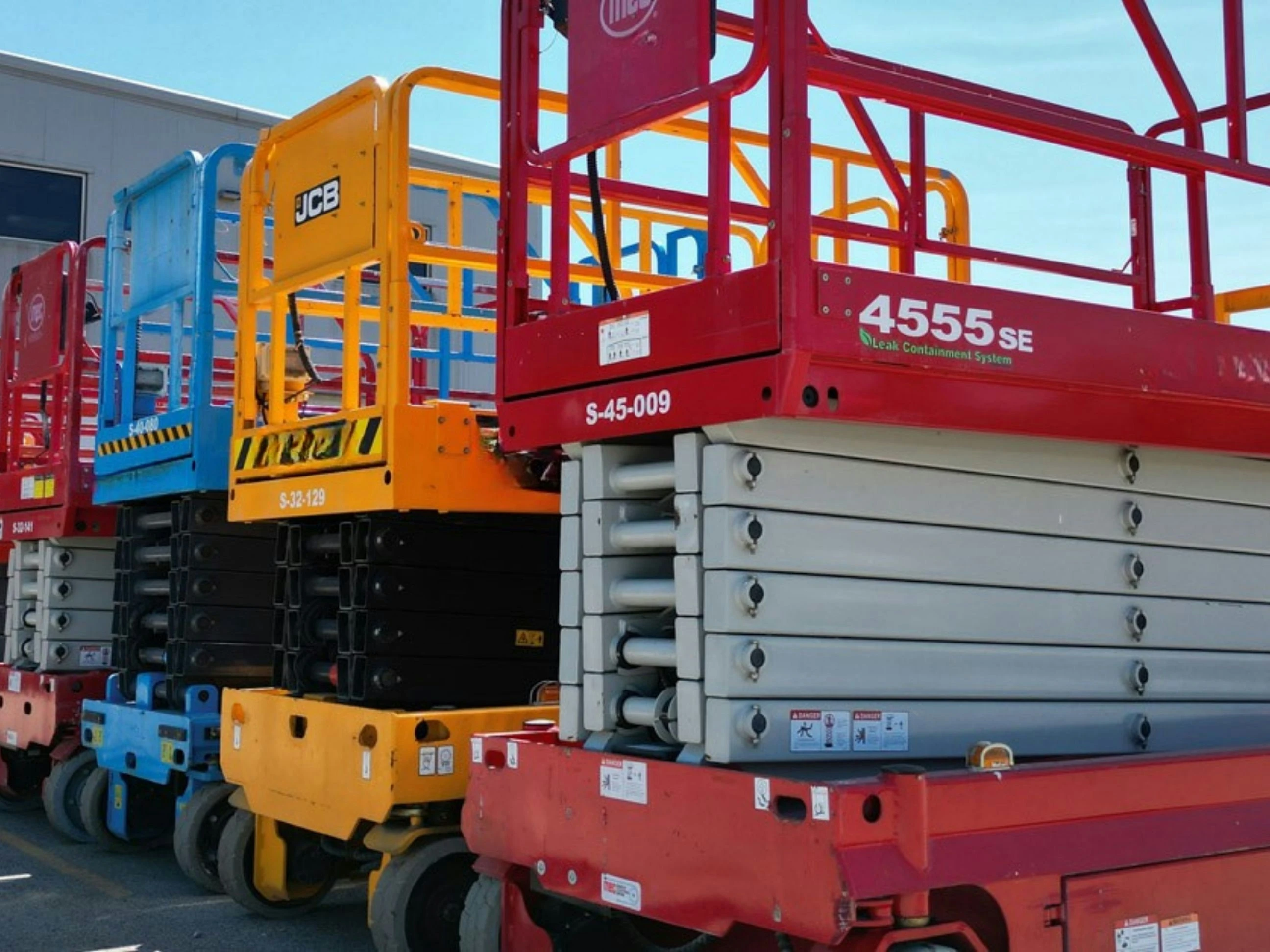
Personnel Lift Rentals in Irving, TX
Call for Pricing & Availability(214) 393-5107Call to discuss personnel lifts pricing, availability and jobsite requirements.
Personnel and vertical mast lifts provide practical, compact solutions for facility maintenance and indoor work in Irving’s commercial and industrial buildings. These lifts offer maneuverability for tight spaces, varying platform heights to suit different tasks, and options between push-around and self-propelled models to match operational needs. Understanding their features helps Irving contractors and maintenance crews select the right equipment for safe, efficient elevated work.
Compact elevated accessWhat Makes Vertical Mast Lifts Suitable for Irving’s Indoor Facility Tasks?
Vertical mast lifts are designed to provide compact, vertical access for one or two workers in confined indoor environments such as warehouses, retail facilities, and office buildings common in Irving. Their slim footprint allows easy navigation through narrow aisles, doorways, and cluttered spaces where larger aerial lifts cannot operate efficiently.
These lifts vary between push-around types, which require manual positioning, and self-propelled models that enable operators to drive the lift platform while elevated. This versatility supports diverse indoor maintenance activities, from replacing ceiling lights to HVAC servicing, optimizing productivity without compromising safety.
When planning for indoor operations in Irving’s diverse commercial facilities, selecting equipment that balances compact design with sufficient reach and load capacity is critical. Evaluating the specific job requirements, space constraints, and floor conditions before choosing between push-around or self-propelled vertical mast lifts will streamline maintenance workflows and improve safety outcomes.
How to Choose the Right Platform Height and Capacity for Your Irving Project?
Selecting the appropriate platform height depends on the specific indoor task requirements and ceiling heights typical in Irving’s commercial buildings. For example, a JLG ES1230 vertical mast lift offers a platform height of 12 feet and a 500-pound capacity, suitable for routine maintenance in retail or warehouse settings with standard ceiling heights. Additionally, consider the nature of the tasks to be performed on the platform. For example, if technicians need to carry bulky tools or multiple components, opting for a higher capacity lift such as the JLG E25MCL with a 350-pound capacity and 25-foot platform height may be more appropriate. This ensures adequate space and weight allowance without compromising maneuverability within typical Irving indoor environments.
For higher reach needs, models like the JLG E18MML provide an 18-foot platform height with a 400-pound capacity, balancing reach and load for more demanding tasks. Always consider the maximum platform capacity to ensure it accommodates personnel, tools, and materials safely during operation.
What Are the Key Maneuvering and Floor Load Considerations Indoors?
Indoor use requires attention to the lift’s weight and dimensions to avoid damaging sensitive flooring or exceeding load limits. Vertical mast lifts typically have lighter machine weights and non-marking tires to protect commercial flooring surfaces encountered in Irving’s office buildings and warehouses. It is also important to assess the floor load ratings of your facility, as vertical mast lifts vary in weight. Choosing a lift with a suitable machine weight and non-marking tires helps protect delicate flooring common in office and retail spaces throughout Irving. Confirming these factors with your facility manager or engineer prior to deployment can prevent costly damage and downtime.
Doorway clearance is another crucial factor. Many vertical mast lifts are engineered to fit through standard doorways, but verifying exact machine dimensions against site constraints prevents operational delays. Self-propelled units offer enhanced maneuverability, which is especially valuable in tight or congested indoor spaces.
When Is a Mast Boom Lift with Outreach More Advantageous?
Some Irving projects require access not only vertically but also horizontally around obstacles, such as servicing fixtures behind pipes or ductwork. Mast boom lifts with a rotating jib and horizontal outreach, like the JLG Toucan 32E, provide up to 32 feet platform height and nearly 15 feet of horizontal reach, offering greater flexibility.
These lifts maintain a compact base footprint while allowing operators to position themselves precisely in industrial or retail environments where fixed vertical lifts cannot reach. However, they require slightly more floor space and have higher floor loading, so site assessment is essential.
For projects requiring horizontal outreach beyond vertical elevation, mast boom lifts like the JLG Toucan 32E offer significant advantages. Their ability to extend nearly 15 feet horizontally enables access around structural obstacles without repositioning the base unit frequently. However, these machines demand careful floor load assessment and clearance verification to ensure compatibility with Irving’s indoor environments.
Questions about personnel lifts?
Discuss equipment requirements, project dates and site conditions by phone.
What Safety Practices Ensure Proper Operation of Personnel Lifts in Irving Facilities?
Safe operation begins with thorough training on the specific lift model, including understanding platform capacity limits, emergency lowering procedures, and proper use of fall protection equipment. Irving facility managers should ensure operators are certified according to OSHA and ANSI standards relevant to aerial work platforms. Operators should also perform a thorough site survey to identify potential overhead obstructions and confirm ceiling heights exceed the lift’s maximum platform height by a safe margin. Employing fall protection harnesses properly anchored to the lift’s designated points is mandatory to comply with OSHA regulations and enhance operator safety during elevated tasks.
Routine pre-use inspections focusing on platform controls, guardrails, tires, and battery charge status prevent accidents. Additionally, verifying that floor surfaces are stable and free of debris reduces tipping risks. Adhering to manufacturer guidelines for maximum platform height and load ensures compliance and safety.
Recommended Equipment Selection Checklist for Irving Facilities
Assess the maximum platform height needed based on ceiling heights and task requirements. For standard indoor maintenance, 12 to 18 feet typically suffices, while specialized tasks may require up to 25 feet. This training should also include familiarization with the specific model’s control panel, understanding of emergency stop functions, and clear communication protocols when working in teams to ensure coordinated movements and prevent accidents.
Verify floor load capacity and surface type to select lifts with appropriate weight and non-marking tires to protect flooring. Pre-use inspections must be comprehensive, checking for any mechanical wear, hydraulic leaks, or electrical faults. Operators should also verify the battery charge levels, ensuring the lift can complete the required tasks without interruption, and confirm that all safety devices such as guardrails and emergency lowering systems are fully functional.
Measure doorway dimensions and aisle widths to confirm the lift fits comfortably without obstruction. It is equally important to assess the work area for hazards such as overhead obstructions, slippery surfaces, or debris that could impact the lift’s stability or operator safety. Maintaining a clean and organized workspace reduces risks and facilitates smooth operation.
Determine if push-around or self-propelled models better suit the operational area size and task frequency. Operators must strictly adhere to the manufacturer’s load limits to avoid tipping or structural failure. Using the lift within its rated height and weight capacities ensures safe operation and prolongs equipment lifespan, reducing maintenance costs and downtime.
Ensure compliance with local safety codes and operator training requirements before deployment. Finally, establishing clear site rules for lift operation, including designated travel paths and exclusion zones, helps prevent collisions with other personnel or equipment. Regular refresher training and safety audits are recommended to maintain high safety standards in Irving facilities.
Explore equipment categories
Common questions
Can vertical mast lifts be used on uneven indoor floors?
Vertical mast lifts are intended for smooth, level surfaces typically found indoors. Uneven floors can compromise stability and safety. For uneven or rough terrain, other equipment like rough-terrain scissor lifts is more appropriate.
What is the difference between push-around and self-propelled vertical mast lifts?
Push-around lifts require manual positioning by pushing the base, suitable for small, confined areas. Self-propelled models allow the operator to drive the lift while elevated, improving mobility and efficiency in larger indoor spaces.
Are personnel lifts suitable for outdoor use in Irving?
Personnel lifts and vertical mast lifts are primarily designed for indoor or slab-surface use. Outdoor conditions such as uneven ground or weather exposure typically require rough-terrain or boom lifts designed for those environments.
How do I determine if a vertical mast lift fits through my facility’s doorways?
Check the lift’s width and height specifications against your facility’s doorway dimensions. Many vertical mast lifts are designed for standard doors but confirming measurements prevents access issues on site.